Life and work of Jaap Schreurs (1913-1983) Painter and father |
|
6.0 Life and work - a second marriage |
With his second marriage, Jaap changed his home address in Utrecht. However, after the long years of dreaming of happiness, it now turned out that both experienced an insufficient match between their lifestyles. Four years later, they decided to have separate home addresses. This revised setup was sealed with a heartfelt mutual commitment that they would continue to support each other in their work and development.
|
|
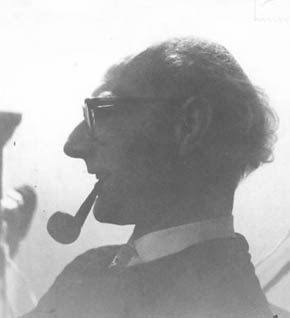
After the lively boardinghouse and the subsequent pangs of love, Jaap now lived alone. For the first time since the studio period in The Hague, he had all the time in the world for his work again. Jaap lived without luxury. He liked to make time for others with a cup of good coffee and a pipe of tobacco. Paula also liked to visit him during her lunch break from work.
|
 |
|
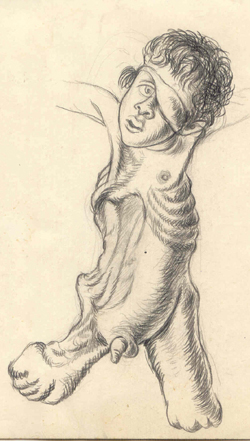
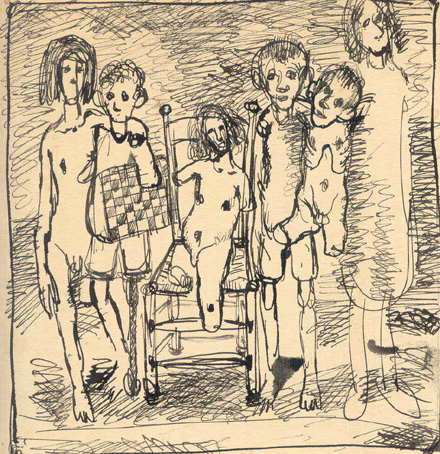
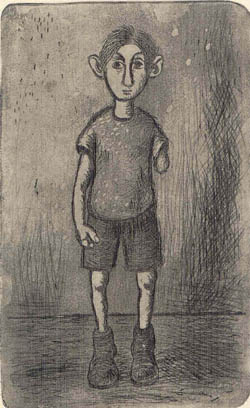
Jaap was affected by the reports about napalm bombs in the Vietnam War as well as (caused by ill medical treatment) birthdefects in babies (in the Netherlands and Belgium known as Softenon babies). Several of Jaap’s works testify to their mutilating impact.
Softenon (Thalidomide) baby ± 1975 pencil on paper 29x21 cm |
 |
|
Softenon (Thalidomide) family with chessboard ± 1975 ballpoint on paper 16 x16,5 cm |
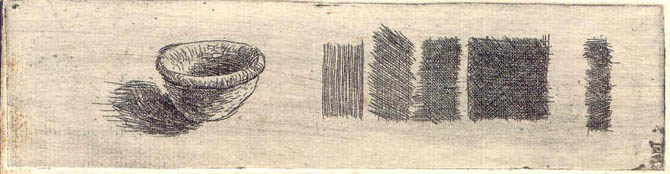
From 1973, Jaap, together with Nelleke, developed his own etching technique. This method implies a different approach to expression than applying paint to the canvas with a brush,
In the same period, Jaap traveled with Nelleke to Paris. There, at the sight of the sunny impressionists, he wondered why he ‘should’ work with heavy colors and heavy themes all the time, and sighed that he longed for that sunny yellow. In the years that followed, finding and introducing this color into his work became a true, emotional quest for him.
|
Boy without arm, etching, after 1977 |
|
As an autodidact, Jaap developed his own etching techniques. |
Etching- Street singer 15,5 x22,7 cm |
|
Etching- Woman with hat
With closed eyes |

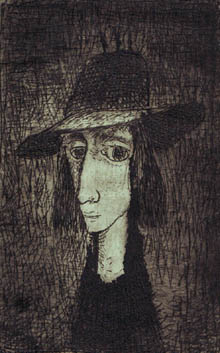
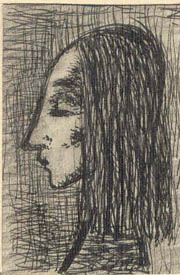
Three heads etching 15x10 cm |
 |
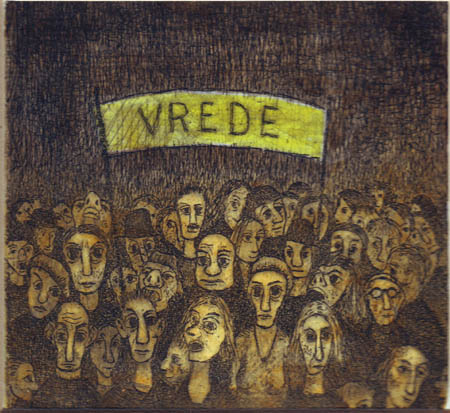
These were also the years of the anti-nuclear bomb protest marches and the demonstrations against the Vietnam War. His etchings were Jaap’s way of protesting.
He looked with amazement and admiration at the work of Gross Arnold, who managed to bring so much color to his etchings. Again, Jaap attempted to develop this technique himself.
In addition to the etchings, very large, emotionally charged paintings were also created during this period. These have been published elsewhere. |
 |
|
1965-1978 |
a second marriage |
|
1978-1983 |
final years |
1951-1965 |
life ande work with the |
family in Utrecht |
|
access to all periods |
by Nelleke and Paula |
|